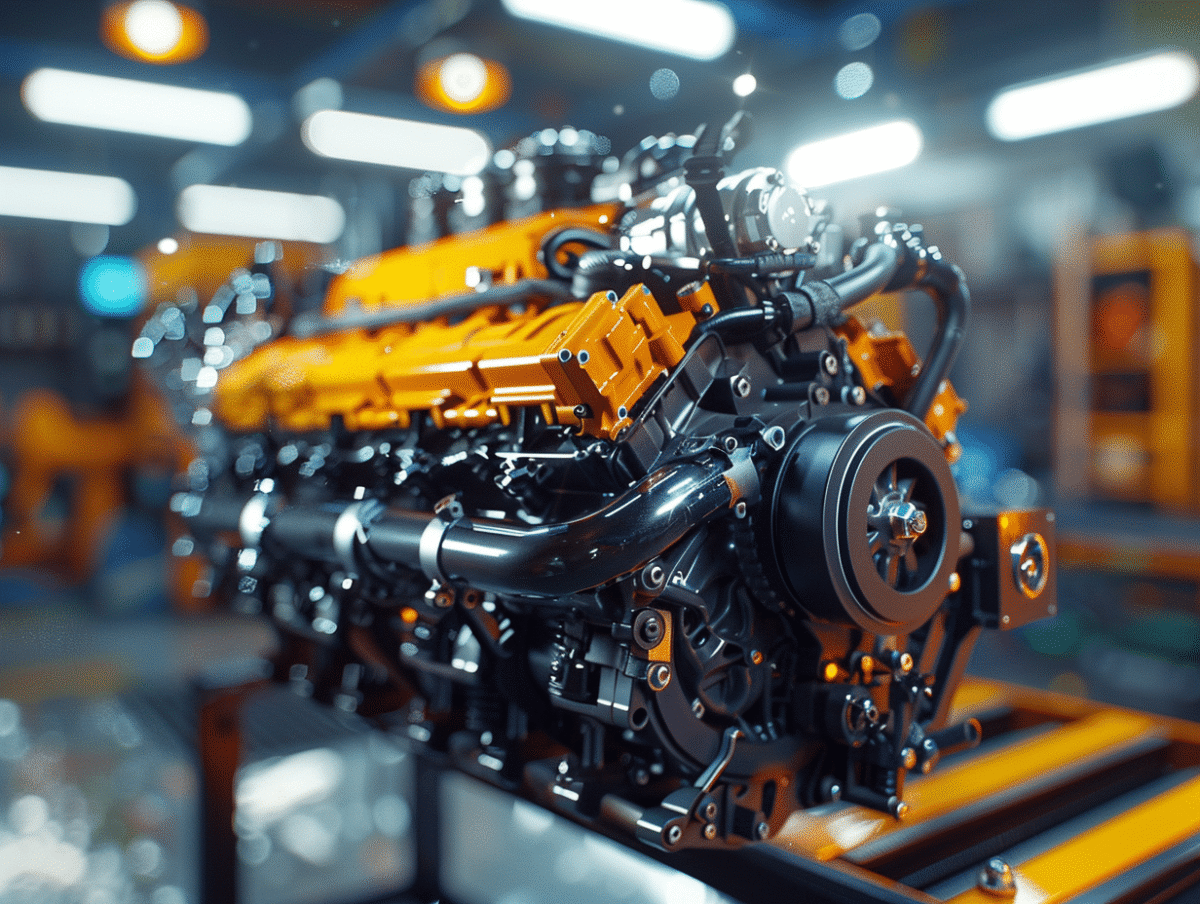
The purring, hissing, or clattering sounds coming from your vehicle’s heart are much more than mere noises: they are key indicators of your engine’s health. Each sound produced by the complex mechanical assembly under the hood results from a multitude of physical phenomena, from internal combustion to metallic interactions. Understanding these acoustic signals can be fundamental for preventive maintenance, helping to avoid costly repairs and ensuring optimal performance. Delving into the origin and meaning of these sound effects can reveal valuable information about your engine’s operating conditions.
Understanding Your Engine’s Noises: Origins and Mechanisms
The acoustics of engines is a complex field of study, combining mechanics and vibration physics. Each sound emitted by an engine results from a series of vibrational and acoustic phenomena, from the most subtle to the most pronounced. The vibrations generated by the various components of an automobile engine are transmitted to the air in the form of pressure waves, which we perceive as noise. These sounds vary in frequency and intensity depending on the nature of the mechanical interaction, whether it is the friction of parts or internal combustion.
Electric motors, key components of electric vehicles, are often praised for their silence compared to combustion engines. However, they are not free from noise disturbances, and their vibro-acoustic performance remains a differentiating factor. Electric vehicles, powered by these motors, use energy stored in rechargeable batteries, which leads to specific noises due to electrical and electronic systems.
Acoustic analysis has allowed for the deciphering of certain characteristic sound behaviors of high-performance vehicles, such as pop and bang, a spectacular sound phenomenon often associated with sports cars during rapid deceleration. This sound signature is the result of the combustion of unburned fuel in the exhausts, creating a distinct detonation. While this noise may be aesthetically appreciated by some car enthusiasts, it remains a sign of a precise and controlled mechanical reaction.
To understand and master these sounds, organizations such as CEVAA model and measure the vibro-acoustic performance of electric motors. Through advanced system simulations, engineers can isolate and analyze noise sources, thus considering solutions to mitigate or eliminate them. This work in the design of modern vehicles, where acoustic comfort is a significant selling point.
From Analysis to Optimization: Reducing Engine Noise Disturbances
In the face of the need to reduce engine noise disturbances, the scientific technique of acoustic optimization is evolving. The tools for system simulations are multiplying, allowing experts to anticipate and correct vibrational phenomena from the design phase. The engineering office CEVAA, recognized for its expertise in acoustics and vibrations, deploys its documentary and technical resources to optimize the performance of electric motors. The fruitful interaction between numerical simulation and practical testing allows for precise targeting of unwanted acoustic pressure sources.
In this quest for silence, the FROID project emerges as a fundamental milestone. This research project, which analyzes the vibro-acoustic behavior of an electric motor at temperature, is structured around two distinct phases: one at ambient temperature and another in extreme cold conditions. The study focuses particularly on the electric car model Peugeot e208, used as a study support for its motor. The data collected is crucial for understanding the impact of low temperatures on noise disturbances and for developing suitable solutions.
The collaboration between CERTAM and CEVAA, within the FROID project, is supported by the research institute Carnot ESP, which funds this initiative. The objective is clear: to reach a new level in reducing noise disturbances, to offer electric vehicle users a more comfortable and environmentally sound driving experience. Applied research and industrial development combine to shape the engines of tomorrow, quieter and more harmonious for the human ear.